Sunday, November 22, 2015

Old Needmore in Fall

Before I get to today's blog entry, I wanted to share an update on a previous entry. Shortly after posting last month's blog, I was able to get in touch with Larry Stallcup, who is a genealogist extraordinaire for the Stallcup family.  Larry informed me that the picture of Almarine Stallcup that I had located was actually only one half of a picture, and that the individual in the other half was in fact Pansy.  Furthermore, the picture had been taken on Pansy's wedding day.  I was thrilled that Larry generously shared it with me and allowed me to post it on the blog.  You may see the updated picture here.
 
And now onto this week's posting.
________________________________________________________________________
 
As Thanksgiving is right around the corner and thoughts of autumn seem to disappear the day afterward in favor of Christmas, I wanted to give fall one last salvo.  In October, my middle daughter and I took one of my favorite walks in the county - along the Little Tennessee River in the Needmore area.  In addition to its extraordinary physical beauty, this walk is extremely rich in human history that I have not yet explored in as great a depth as I would like to (but plan to).  This is essentially a photo essay but I will fit tidbits into captions as I am able.  I am indebted to Ed Ammons and David Dehart for sharing their historical knowledge of this beautiful place with me, so that I may pass it along to you.

The Little Tennessee River, viewed from the swinging bridge.

The swinging bridge, taken from the east side of the river.  Swain County resident Bill Burnett
grew up in a home that once stood adjacent to the bridge.

The road (beyond the gate) heading to the Burch McHan (1823-1895)/ (Doyle Hampton (1904 - 1977) place.


Sunlight shines through the fiery leaves of a sourwood tree.


One of several beautiful old fields along the road. 
The Doyle Hampton place sits slightly up the hill in the middle of this picture.


A hand-dovetailed log from a fallen outbuilding.

A bumblebee on one of the ubiquitous gentian plants blooming along the road. 


The chimney at the Doyle Hampton place, which remained standing until not many years ago.


The remains of an old barn at the Doyle Hampton place.


A grand old walnut marks a home site.


The tombstone of little Sarah Davis (01 June 1873 - 05 January 1874) in the original
Brush Creek Baptist Church cemetery.


Thistles in one of the old (still tended) fields along the road.


A rusted plow point harkens back to days when farmers plowed these fields with horses and mules and not tractors.

A maple leaf floats in the river.


A yucca marks an old home place near the confluence of Brush Creek and the river.


The Little Tennessee River, looking upstream. Ed Ammons shared with me a childhood recollection of crossing the river in an old flat-bottomed boat with a kerosene lantern on the way to a prayer meeting at Lon Dehart's.  His dog, Pooch, swam alongside.

For those who are interested, directions are as follows.  Turn left onto Needmore Road just before the junction of US19 (toward the Nantahala Gorge) and NC28 (toward Almond Boat Dock), and drive several miles.  After cresting the hill at the Maple Springs church, the road begins to head downhill toward the river and the parallels it for a way.  It then leaves the river for a brief distance then returns to parallel it.  Just before the road once again begins to head away from the river, you will see an old swinging bridge going across the river on the left.  Park in the small lot here, cross the bridge, and turn right to begin your walk.

I wish each of you a blessed Thanksgiving!

Saturday, October 3, 2015

Departed this Life (October 1915)

Between working full-time and raising 3 children, it's often difficult for me to find the time to write lengthy blog entries. As such, and in order to keep putting out information on Swain County, I've thought long and hard about what types of articles would be of interest to my readers, but take me a little less time (don't worry - the longer articles will still come!).  Today's blog is an example of one thought I had, that of profiling individuals who died in Swain County during the current month, any number of years ago.  For this particular entry, I chose 100 years.  I'd love some reader feedback at the bottom; is this article type one you'd like to see continue?

I hope you'll enjoy learning about some of the interesting Swain County individuals who departed this life in October 1915.
_______________________________________________________________________

October 4th
William Franklin Garrett (born 1851), a 64 year-old lumber inspector at the time of his death, took his life by a shot to the head somewhere in the Oconlufty township.  He was born in the Jonathan Valley area of Haywood County, son of William Green Berry Garrett and Martha Jane Rodgers.  In 1877, he married Mollie Ophelia Thompson, and they had one known child: a daughter, Susan. He served as the postmaster of the Jonathan's Creek post office from1871 to 1877. He is buried in the Garrett Cemetery in Haywood County.  Click here for his Findagrave.com memorial.


Champion Lumber Mill at Smokemont, date unknown (This may or may not have been the logging operation with which William Garrett was associated).  (Source: WCU Digital Collections.)

October 13th
Nancy (nee' Angel) Cunningham (born 1830), an 84 year-old widow, died of old age in the Almond area. She was born in Macon County and was the daughter of William Angel and Martha 'Pattie' Shepherd.  In 1856, she married James Mont Cunningham, with whom she had 4 known children:  William Avery, Robert Jefferson, Susannah, and Charles Thaddeus. Old deeds appear to indicate that the Cunninghams lived on the Little Tennessee River.  According to her death certificate, Nancy is buried in an unknown cemetery in the greater Ela area of Swain County.


Little Tennessee River in Swain County, 1937 - location unknown
(Source: WCU Digital Collections)
October 19th
Timmie Ross (both 17 Feb of the same year), a 7 month-old infant, died of 'pneumonia fever' at Stonery (near the location of the new Cherokee School on Big Cove Road).  He was born in Swain County and was the son of Adam 'Tewatley' Ross and Desdemonia Crowe.  At the time of his death, he had a sister, Katie.  Timmie is buried in an unmarked grave, in an unknown cemetery in the greater Big Cove area of Swain County.

Of tangential interest, Timmie's father was one of the Cherokee schooled for a time at the Carlisle Indian Industrial School in Carlisle Pennsylvania.  He ran away back to home in 1900, something he later came to regret as shown in the letter below.  Adam's file from the school may be viewed online here

Letter from Adam Ross to the Carlisle School (Source: Carlisle Indian School Digital Resource Center)

October 25th
Birch/Burch Messer (born 1893), a 22 year-old logger, died of bronchial pneumonia at Bushnell, attended by Dr. J.E.T. Welch, a prominent citizen of the area.  Birch was presumably born in the greater Dillsboro area of Jackson County and was the son of William Robert Messer and Nancy Avaline Parton.  He was single at the time of his death.  He is buried in the Locust Field Cemetery in Jackson County.  Click here for his Findagrave.com memorial.
Coming into Bushnell, 1938 (Source: NARA)

October 25th
William 'Bill' Wildcat/Wild Cat (born in the early 1840s), a 75 year-old farmer, died of unknown causes somewhere in the Oconalufty township. As I am not a Cherokee historian, I cannot be certain of his lineage.  However, by matching US Census Records with Indian Census Rolls, he appears to have been the individual shown in the screen capture below from the 1899 Census for the Eastern Band of Cherokee Indians. If my supposition is correct, he was married to a woman named Rebecca, and had 3 children living with him at the time: daughters Arline and Stetsey, and son Palneola (as best I can make out).  He is buried at a cemetery in the Birdtown area, presumably the Wildcat-Ben Cemetery, in an unmarked grave.

Source: 1899 Census - Eastern Band of Cherokee Indians on Ancestry.com


 October 28th
Pansy E. (nee' Case) Crisp (born 1895), a 20 year-old housewife, died of tuberculosis at Bryson City. Pansy was born in Swain County and was the daughter of Fidelia Gaston 'Jack' Case and Kansas Mary Jane Stallcup.  She was orphaned in 1905 upon the death of her mother (her father died in 1896), and was taken in to live with her maternal grandparents, Lucius Harvey and Maude Almarine Elizabeth Stallcup.  In 1913, she married Frederick Ira Crisp.  They had no known children together during their brief marriage. Pansy is buried at the Bryson City Cemetery.  Click here for her Findagrave.com memorial.


Maude Almarine (Hall) Stallcup (left), grandmother of Pansy (Case) Crisp (right) on Pansy's wedding day.
Source: Larry Stallcup
 
These are the only individuals whose deaths were recorded via death certificates for October 1915 in Swain County.  However, as death certificates had been in use for a short time only, more often than not, deaths often went unrecorded.  There can be no doubt that there were many other Swain Countians who died in October 1915, some whom we can discover through their headstones, and others who lie in unmarked graves, their identity lost to history.
______________________________________________

As always, I welcome and appreciate reader input.  Knowing of your interest in what I write enables me to remain enthusiastic about writing it!  Today, I'd love some reader feedback in the comments - is this article type one you'd like to see continue?

_____________________________________________________________________
Sources:
Ancestry.com
Carlisle Indian School Digital Resource Center
Findagrave.com
National Archives and Records Administration, TVA Files
Western Carolina University Digital Collections

Sunday, September 20, 2015

The Old Juney Whank Home Place

 
Following is the much-belated epilogue to the past two blog entries written by my research partner, Don Casada.  As a disclaimer, this hike is best-taken by those in good physical condition and who are comfortable navigating in the backcountry.  It is also best-taken during the late fall and winter months, when the deciduous foliage in the area is down and visibility much better.  Should you undertake this trek - enjoy!  It is a very special place.
________________________________________________________________
 
Several folks have gone up Juney Whank Branch looking for home places and have asked me about location and directions to the Casada place, so I thought I’d provide them here.

From the parking lot area near the mouth of the branch, it is – in the words of my father – a country mile to the home.  According to my GPS unit, his country mile is about 1.25 customary miles.  Along the way, you pass three other former home sites, as indicated on the Figure 11 map. 

Those undertaking off-trail wandering are well-advised to study maps before heading out, especially if you’re seeking a particular location.  Juney Whank Branch has some of the standard vegetation that you have to deal with in the area – rhododendron and greenbriers – but relative to many other locations in the Smokies, it is a relatively easy bushwhack.  One important point to remember is that if you get turned around or confused, simply follow the stream downhill as it winds its way toward Deep Creek. 
Here are some general directions to what was once the Casada home place: 
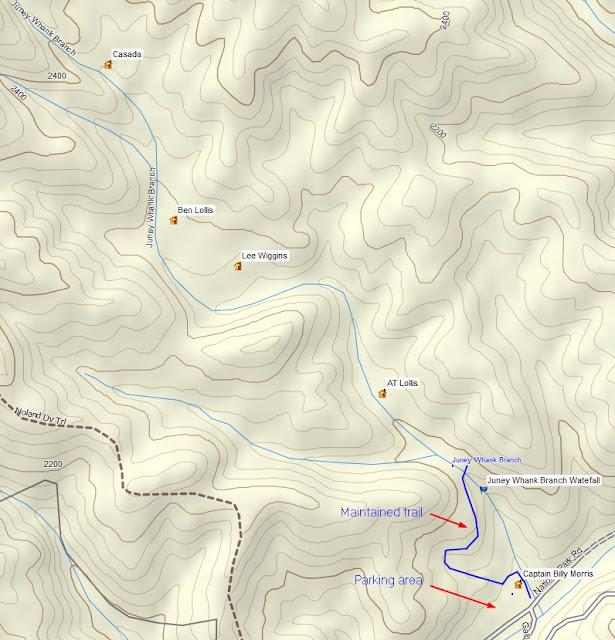
Figure 1: Juney Whank Branch map, with former home places marked


 Starting at the parking lot, located near the mouth of Juney Whank Branch and the trailhead for the Deep Creek trail.  From the parking lot, turn left to follow the trail toward the Juney Whank Falls.  The climb, by trail, to above the falls will get both your heart and lungs pumping; the trail portion is actually the hardest part of the trip.  Continue on up the trail to above the falls (which you’ll see to your right as you ascend).  Cross the branch, turn left and start on an unmaintained wagon road, immediately passing a springbox with a pipe water spout.  If you want to follow the old wagon road from this point, that’s fine, but I usually veer off the road to the left just as it starts to climb a bit and walk through the quite open woods.  In late winter and early spring, you’ll spot a patch of jonquils just after getting off the road.  Continue to wander up the drainage, staying on the right (east) side of the branch. 

About 0.2 miles after leaving the road, be on the lookout for an old washtub, lying alongside a patch of jonquils.  This is all that marks a former home place which was owned by A.T. (Tom) Lollis.  I don’t think that Tom’s family ever lived in it, however; they once lived near the mouth of Hammer Branch (to the north) and later near the mouth of Durham Branch, near the pavilion in the Deep Creek campground area. 

As you continue on up the branch, the walls will pinch in on either side, and you’ll run back into the old road as it closes in on the branch.  I normally go ahead and wade into the rhododendron at this point and follow the road.  There are a couple of trees that have fallen across the road which you’ll have to crawl under or navigate around, but overall, it’s not a bad go. 

Shortly after crossing a small feeder branch coming in from the right (coming out of Hall’s Holler – a story for another time), you’ll pop out of the pinched-in section to where things open up substantially.  Leave the old road and cross a small branch which runs right beside the road and traveling through a two-or three-foot deep gouge.  Look for a patch of yellowbells, washtubs, and in the midst of a thicket, a fallen chimney.  This was the Lee Wiggins home.

Beyond that home, bear a little off to the west, away from the road.  Cross Juney Whank Branch and look for the home of Ben Lollis.  Although the marker in Figure 1 shows it on the east side of the branch, it is actually on the west side of the branch (the topo map is off). Just below where the home stood is a sizable collection of automobile parts, including the driveshaft and rear end, brakes, engine mount and other pieces.  The home spot is marked by a fallen chimney pile just above the vehicle parts.  Also nearby is other detritus, including terra cotta pipe and bits of galvanized metal roofing.  Not far above the chimney pile is a flattened out spot where a barn once stood.
 
Cross back to the east side of Juney Whank Branch and continue up the drainage.  If you watch closely, about 0.15 miles above the Lollis home, you’ll run into the wagon road, with some sizable rocks on either side of it.  I don’t usually follow that road – although it will take you to the home place.  Instead, I cross it and continue until I reach the noticeably larger trees toward what was the lower end of the garden area.  On the left is a good-sized maple; on the right is a two+ foot diameter red oak.  On up above are other fine tree specimens – all second-growth.  The largest yellow poplar in the area, which my wife, Susan stands next to in Figure 2, is a good reference point.

Figure 2:Casada home place area. Vegetation - japonica, daylilies, and mock orange - mark the home site location. About 20 yards beyond the home is a rocked-in spring, below which, in a broad flat section, there once stood a spring house.


 Above the home site, a rock wall runs an east-west course across the hollow.  The area above this was fields.  On above that was pasture.  About a quarter mile above the home site is a two-hundred yard long rock wall which winds along a section of wet weather branch.  That rock wall served a dual function – a place to relocate rocks from the pasture and field areas and to provide erosion control from the considerable flow that courses that wet weather stream following heavy rains.
 
 
Figure 3: Part of the long rock wall along the wet weather branch
Light and set
Let me close by saying that in my view, were the folks who once called these places home still alive to ask, I think that they’d be absolutely delighted if someone came by to visit – either before or after they left the place behind.  So, by all means, go by and “set a spell.”
 
When I visit a home place – particularly this one – I like to sit on a log in the sun in winter or a rock by the branch in warm weather and let my mind carry me on a journey back to when there were sounds of children’s laughter as they hemmed in spring lizards and the satisfying crack of white oak splitting from a solid whack; the smells of wood smoke and freshly-turned soil; the sights of a barefoot boy carrying a bucket of spring water to the house in the gloaming and strings of leather britches hung across the porch in late summer to dry.  Those were hard days, inhabited by folks tough beyond modern measure.  I’m confident that many would not trade the lives that they had later on for those earlier, harder ways (my grandparents and parents certainly included).  Still, there was –and is, among the dwindling few who once called these remote places home – a deep sense of affection for the time and the place where they were raised. 
 
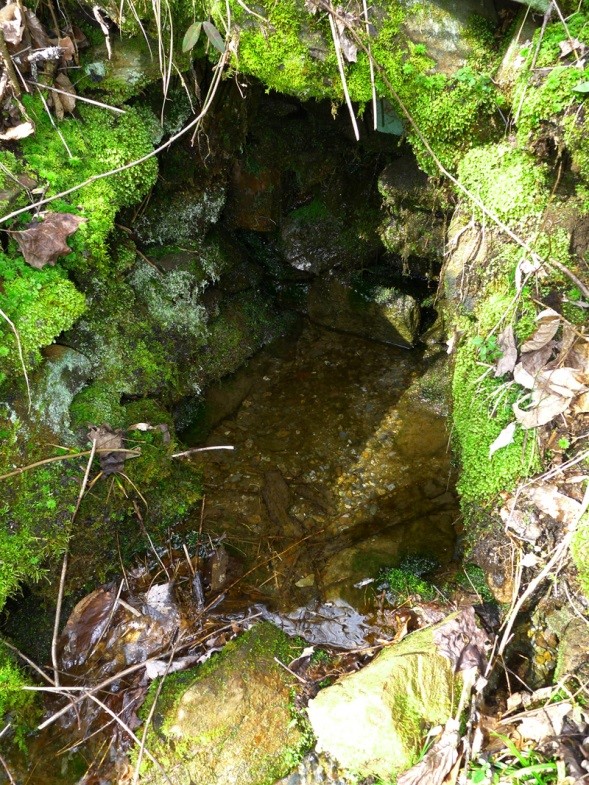
Figure 4:  The old spring.
 
Random Thoughts and the Musings of a Mountaineer, written by Judge Felix Alley and published in 1941, is a book long out of print and hard to come by.  Alley was a man whose love of these mountains was surpassed by his love of his kindred mountain people.  He noted that the poem below by “Mr. J.W. Clay, citizen and poet of Winston-Salem” expressed his sentiments fully.  It does mine as well, particularly when I pay a visit to the Casada place, a country mile up Juney Whank Branch.
 
A Little Log Cabin in the Mountains
J.W. Clay
 
A little log cabin in the mountains
A spring, and a creek running by,
The deep solemn silence of the wild-wood,
Broken by the screech owl's cry.
 
A meadow that harbors a hay-stack,
A field where the golden-rod blooms,
A hill where hides the arbutus,
Where tall the great oak tree looms.
 
A garden of old-fashioned flowers,
The hollyhock, marigold, and rose;
A plot with vegetables growing,
With onions and cabbage in rows.
 
The whinny of the horse in the pasture,
A cow in the shed, and a calf,
A pig in the pen making a noise,
That is neither a cry nor a laugh.
 
A cock with a dictator strut,
Some pullets and hens running 'round,
A fretting old 'cluck' with her brood,
Scratching for worms in the ground.
 
A blazing wood fire in the winter,
When snow is covering the ground,
A cat on the hearth-stone purring,
And a lazy but faithful old hound.
 
I have traveled the far-away places,
I have crossed over mountain and sea,
I have seen the great cities in splendor,
But their splendor holds nothing for me.
 
For I love my log cabin in the mountains,
It is humble, but still it's my home,
And never again shall I leave it,
Across the wide earth to roam.
 
Of course I live in the city,
Like you, and other poor devils I know,
But my heart and my soul are in the mountains,
Where memories, like warm embers glow.
 
  ____________________________________________________