Showing posts with label White Oak. Show all posts

Sunday, May 24, 2020

Memorial Day - Remembering Corporal Everett Bates (1895 - 1918)

Two years ago, I published an article on the Tabor Cemetery. One of the graves I visited at the cemetery was that of Everett Robert Bates, a young Needmore-area farmer who died in World War I. Although all war deaths are tragic, his seems particularly so to me. Why? In addition to his youth and the impending birth of his first child at the time of his death, Everett died in the waning hours of the war, quite literally. He perished sometime between 6 a.m. and 11 a.m. on November 11, 1918 - Armistice Day - the very day upon which the war ended. As Memorial Day is nigh, I felt that a remembrance of this brave young man was in order.
Everett Robert Bates (taken September 26, 1917)
Source: David DeHart
Everett Robert Bates was born in the Needmore section of Swain County on September 27, 1895, the fourth child (of at least 13) of William Jefferson and Sally Jane Levinia (nee' DeHart) Bates. Little is known of his young life but it may be assumed it was the typical life of a child of rural Swain County during that time. He likely attended either the Hightower School or the White Oak School as a youngster, as the 1910 census reveals him to have been able to both read and write, and probably attended one of the churches in the area - perhaps Maple Springs or Brush Creek. He appears to have farmed for a living during his brief adult life. In 1917, the 'Great War' in Europe came knocking upon the doors of the young men of Swain County and Everett was required to register for the draft. His draft card (dated June 5, 1917) reveals that at the time, he was single and working as a farmer for Charles Rastus Browning in the Needmore area. He married Lillie May Marr (1899 - 1978) just 3 months later on September 26th. 
Everett Bates draft registration card
Source: Ancestry.com and Fold3.com
Everett Bates and Lillie Marr (top row) on their wedding day (September 26, 1917).
Seated in this picture are Lillie's sister Nell and Everett's friend Columbus 'Lum' Winchester.
Source: David DeHart
It is almost certain that Everett and Lillie's marriage occurred when it did due to his being 'called up' for duty. For though he had tried to claim exemption from the draft due to disease, his number had been pulled and he left via train for Camp Jackson in South Carolina, just days later on October 2nd. He was enlisted in Company I of the 321st Infantry Unit (the 'Wildcats'), 81st Division of the U.S. Army. Over the next nine months at Camp Jackson, he actively trained for near-certain deployment to the Western Front in Europe. He appears to have had the chance to return home at least once during his training, as Lillie became pregnant in the spring of 1918 but on July 31, 1918 he embarked on the 'City of Glasgow' to go to Europe with his fellow soldiers, never to return alive. 
The 'City of Glasgow' - the ship which transported Everett Bates to Europe in 1918.
It was torpedoed and sunk off the coast of Ireland one month later.
Source: wrecksite.eu

Everett Bates embarkation record
Source: Ancestry.com and Fold3.com
The activities of Everett's division during the three months prior to his death are recorded elsewhere (link below) and in the interest of saving space, I will not detail them here. However, we are exceptionally privileged to have access to the diary of another soldier in the 321st, who wrote in great detail about the events that transpired on the date of Everett's death at the Battle of Moranville in France. The full diary is located at this link, but I have excerpted small bits and pieces to provide the reader some idea of the awful realities that Everett faced on that last day of his earthly existence.

'About 5 o'clock (am) we walked around and looked at the sleeping company in their little shell holes, every one in a shell of his own. I wondered how many of them would be living at noon that day and I thought how hard it would be to arouse them from a peaceful sleep to go out to kill and be killed. At this time we called the men....the men rubbed their eyes and tightened their belts for there was no water to wash their faces or food to fill their stomachs. The men took it good naturedly and prepared to go over the top.....
The high explosive shells were falling just as though it was raining them from above....we could hear the continuous ring of M.G. (machine gun) fire and every now and then a man could be seen going to the rear carrying a bullet pierced arm or limping back on a leg that had been shot...nothing could stop us as long as life lasted for our orders were to take Attain or die trying. 
We were lost in a fog and wading water waist deep.....we rushed on for some distance and found that we were caught in a trap.....we fought there for some time in the marsh up to our waist and the coldest water I ever felt. We were in an awful fix in a trap sure from all sides and our men were being killed by the M.G. from the front and a box barrage from the rear......Our scouts were out in front of the front wave about 40 yards and the fog was so dense that we couldn't see them at all but we knew very well when they came in contact with the enemy for they opened up with what seemed us a thousand M.G. and a few 77s#'s which they shot whiz bangs point blank at us......
At seven minutes to eleven a runner came up to the Capt. out of breath and handed him an order. I had no idea what the order meant.....as soon as he read the order he called two runners and told them to go to the platoons and give them orders to cease firing at eleven o'clock. At 11 a.m. we ceased firing and the Germans jumped up, threw their rifles down and came running to meet us....We spent the rest of the day gathering up the dead and wounded of the field and they were plentiful. We hauled many loads of dead bodies up and buried them in a hole dug like a long ditch. The men were laid close together, side by side, and covered up...... 
The Germans celebrated all night long by sending up flares and lights from the trenches and they were so glad they wouldn't sleep at all but we were perfectly willing to rest and sleep.'
Thomas 'Jack' Pinkney Shinn, Co. B, 321st Inf., 81st Div., U.S. Army 

Chaplain B.S. Vaughn presiding over the mass burial of the dead at Moranville on November 12, 1918. The graves are marked by small slabs of wood. Everett was one of the deceased soldiers for whom this service was given.
Source: https://www.ncdcr.gov/blog/2018/11/11/north-carolinians-respond-armistice-november-11-1918

Everett was originally interred among this sad line of deceased soldiers described by Jack Shinn. It is not known how his demise was conveyed to his wife and family, though it is almost certain they received the news via telegram. His death was announced in the Asheville Citizen-Times on December 10, 1918. 

'America's Honor List'
Source: Asheville Citizen Times, December 10, 1918
On February 27, 1919, Lillie gave birth to Everett's child, a son that she named after his father. Sadly, however, Everett Robert Bates Jr.'s life was to be cut tragically short as he died on January 1, 1921, of meningitis. Lillie, no doubt devastated by the loss of both her husband and son in such a short period of time, married James Floyd Cunningham just a few months later in March.

Everett Sr. remained in France until  July 1921, when his body was repatriated to the United States (unlike many of his comrades, whose bodies remain buried in foreign soil). He was interred in the Tabor Cemetery near the grave of his son. It is a peaceful and beautiful place for his eternal repose, in the mountains of home - far removed from the horrors of the battlefield upon which he died. 

Everett Bates repatriation documentation
Source: Fold3.com

Tombstone of Everett Robert Bates, Sr. (Tabor Cemetery)
Source: Felicia Mashburn on Findagrave.com
Sadly, for every Everett Bates, whose life is being honored in this article, there are millions more soldiers who were killed in action whose incomplete lives have been long-forgotten over time. Each of them was an Everett with their own story- full of life, with families and friends they loved and who loved them, with plans for a future that they would sadly never see come to fruition. As we celebrate Memorial Day on Monday, May 25th, I would encourage my readers to each take a moment to remember all those soldiers who gave their lives for the freedoms that we and our fellow men around the world enjoy and take for granted. May you each have a blessed holiday.
________________________________________

Notes to the reader: 
  • For those interested in learning more, a full-text file of the book,  'The History of the 321st Infantry' may be found for free at this link
  • The excellent movie, '1917', was released early this year. It won rave reviews for its depictions of the horrors of the Western Front during World War I - I highly recommend it. 
________________________________________

Sources:
Ancestry.com
Asheville Citizen-Times, December 10, 1918
David DeHart
Findagrave.com
Fold3.com
ncdcr.gov
Newspapers.com
wrecksite.eu

Sunday, November 18, 2018

Landscapes of Old Schools - White Oak

At the request of superintendent Charles Carroll, a representative from the North Carolina Department of Public Instruction performed a complete survey of Swain County's schools. The survey was begun in September 1932 and ended in June 1933. The report produced provides fascinating insight into the state of schooling in our mountain county during the Great Depression, and even better - contains pictures of the schools that were visited. I will be using this report in upcoming articles to highlight the past (and current) landscapes of the old schools that once dotted Swain County.
__________________________________________________________
White Oak #1 School
Source: Swain County Schools Consolidation Report (1933)
Swain County once had two one-room schools that bore the name "White Oak". White Oak #1 was situated at the confluence of Sawmill Creek and the Little Tennessee River. Thanks to Lillian Thomasson's extensive research for her book on the early educational history of Swain County, we can know with certainty that the school was operating at least as early as 1892. It likely operated from at least 1890, as an article in the 1890 Swain County Herald mentions White Oak as a voting location.

Source: 1936 Wesser Quadrangle, USGS;
Discussion with Cliff King


During the time the school was in operation, no "School Board" proper existed; instead, the school districts were represented by "School Committeemen". During the year in which the consolidation survey took place, White Oak was represented by William Thomas Davis (1865-1952), William Roby Howard (1876-1952), and Abraham "Abie" DeHart (son-in-law of William Roby Howard), all of whom lived in close proximity to the school.

William Thomas Davis
Source: C Todd Young on Ancestry.com

William Roby and Susan (Slagle) Howard
Source: Swain County Heritage Book

Abie DeHart, wife Lizzie (Howard, daughter of William Roby Howard above), and children
Source: Greg Gilbert on Ancestry.com and Mother June (DeHart) Gilbert
Schoolteachers known to have taught at the school were Lucy Henry (as there were several Lucy Henry's living in North Carolina, her full identity is not certain), Vonnie West (1886 - 1976), and a Ms. Wilhide (first name unknown).
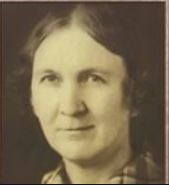
Vonnie West
Source: https://yellow.place/en/aunt-vonnie-west-mill-house-and-west-mill-post-office-franklin-usa
With an enrollment of 33 students and an average daily attendance of 24 at the time of the 1932/33 survey, it is certain that hundreds of Swain County children attended the school over the years it was in operation. Few of their identities are known, however, some are, including:
  • Fred Ammons (father of faithful blog reader Ed Ammons)
  • Rufus King (father of another faithful blog reader, Cliff King)
  • Some of the children of Abie DeHart
Fred Ervin Ammons
Source: son Ed Ammons

Catherine (McHan) King with children Mary Jane and Rufus Veary
Source: Cliff King/Fran Rogers

Children of Abie and Lizzie DeHart
Back Row L-R: Lambert, Percival, George, and Onley
Front Row L-R, Ralph, Kate, and Arvil
Source: Greg Gilbert on Ancestry.com and mother June (DeHart) Gilbert
Another family whose children attended White Oak was that of William Roby Howard. Recently, I had the great honor of talking to his youngest child who is the only member of the family still living. Lexie (Howard) Winchester was born in January 1926 and attended the school for about 2 years - for 1st and 2nd grades (she went to the Bryson City School after the White Oak school was closed). At the age of 92, she is likely to be the last living former pupil there. She had some fond memories of the school that she shared with me, and I hope you'll enjoy them. In places I have moved text around to make the reading more linear, but Lexie's speech is copied almost verbatim.
___________________________________________________________
"I lived off 28 south, but there was a trail we always walked on to school. The schoolhouse was right on the Tennessee River. I walked about 2 and a half miles down there every day. I always kind of liked school, you know? I always went to school - I never laid out.  I was the only one of the 12 children who finished high school. They all quit when they got old enough - you could quit school when you got through the 7th grade. My other siblings - by the time they were grown, they moved other places where they could find jobs. There were no jobs here at that time.
Three of the Howard girls. Lexie is on the right and appears to
be around 6 or 7 - the age at which she attended White Oak.
Source: Lisa Sutton (daughter of Lexie Winchester)
There was one woman - Miss Henry was her name. I guess she was my 1st grade teacher. There was a Miss Wilhide who taught there at one time but she was not my teacher - she was there before I ever went. She taught 1st through 7th grades there. The school year went the same in the little country school schools as in Bryson City - 8 or 9 months.  The schoolhouse faced the playground - the boys played ball and the girls played whatever. There was no equipment of any kind. (Note: Rufus King reported that there was a swing that hung off the large oak tree that White Oak was named for, however, Lexie did not remember it. Lexie's son, Larry, stated that the boys would chase the squirrels up the tree.)

We were all in one big room - 1st through 7th grade. The older kids, like kids who were in the 4th, 5th, and 6th grades, when the teacher was working with the older kids, they helped the little First graders with their spelling and arithmetic. The older kids helped the smaller kids a lot while she was teaching the higher grades, like teacher assistants I guess. (I asked about corporal punishment here.) They used a paddle, because I know I got it used. The older ones, I don't know what they used. But the little ones, they would just paddle your hand if you were talking or misbehaving. I got a lot of little paddlings on my hands for talking.

(I asked if she remembered it being cold in the winter). Well, it certainly was (cold). There was a woodstove in the schoolhouse - it was heated I guess with wood. I don't know if they used coal or not. It was an old fashioned stove with a stovepipe going out the top. That heated the whole room. There was no insulation, I don't guess, in the building. It was one big open room with a wood stove in the middle, why, you wouldn't freeze to death, but it was cold in there. When it snowed and was bad, there were times that they didn't have school when kids couldn't walk to get there.

(I asked if the teacher had boarded in the community.)Yes, I remember Miss Henry boarded with an old Dehart family that was not too far from the school. She lived there with the old lady and her husband.  If she had a car, I didn't know anything about it.

(I asked about friends or other classmates.) I don't remember any girls my age (at school). There was one family who lived right across the river from the schoolhouse - their name was Cabe. They had several kids. I think the girls were older than me. They had a boy about my age (Percival) that I went to school with but there were 2 or 3 other kids in the family and sometimes they would come to school across the river in a boat and take the boat back to the other side of the river when they got out in the evenings. Further down from where they lived there was a bridge across the river - a swinging bridge, they called it, but it was a good ways down from their house. Lots of times they would come across the river to school in a boat and go back home the same way - it was closer."


Lexie Winchester (left) with her mother, Susan (Slagle) Howard
Look at the dresses - they appear to be made of the same fabric.
Source: Lisa Sutton (daughter of Lexie Winchester)
________________________________________
Lexie would almost certainly have been in the 1st grade when the school survey was completed.  The inspector stated the following in his report about the school:
  • Organization: Census 40, enrollment 33, average daily attendance 24. Percentage of students promoted 43.2%. There is 1 teacher; index of teacher training - 600. There are 6 grades and the school term is 6 months.
  • Grounds: very inaccessible and wholly inadequate for school use.
  • Building: poorly constructed, inadequately lighted; very bad in all respects. Fair pupil desks and seats. Water bucket with dipper. Toilets are over the river (Note: this was corroborated by Cliff King, whose father had told him this), the whole situation is deplorable.
  • Recommendation: Make every possible effort to abandon this school at once. Consolidate and transport the students to the Bryson City School.
The White Oak for which the school was named.
Photo taken from the school site, looking toward the river.
Photo by Wendy Meyers
Swain County paid heed to the recommendation. White Oak #1 appears to have been closed in 1934 but the school remained standing for quite some time thereafter. For a time, at least one family called it home. Cliff King also recalled playing in the empty building as a child - remembering a blackboard painted on the front wall and a bell in the attic. When he was older, he boated tobacco from his brother's fields across the river and hung it to dry in the old schoolhouse.

Sadly, Cliff related that the school was burned by arson in the early 1960s.

The school site - the playground would have been in the foreground.
Photo by Wendy Meyers
Cliff King standing at approximately the site of the school's front door.
Photo by Wendy Meyers
Today, if you're willing to walk a bit and get a little wet, you can still visit the site of the old school. It's a beautiful, secluded, and peaceful spot along the river. Walk on the old road built by Joseph Welch and the old settlers of the county nearly 200 years ago - the road traveled by many a young child on their way to school. Stand on the river bank and touch the gorgeous old white oak the school was named for. Drink from the spring that supplied the students' water. Look across and up the river at the old tobacco fields and at the site of the Cabe home and imagine a little boy and his siblings setting out in their boat to come to school each day from there.

Looking upriver from the school. Floyd King's tobacco fields can be seen across the river in about the middle of the picture. The Cabe home sat on the hill to the right.
Photo by Wendy Meyers
And then stand in the playground area and imagine the children scampering about. If you sit still and listen quietly, you can almost hear their laughter.
__________________________________________

Sources:
Ancestry.com
Carol Cochran
Clifford King
C. Todd Young
Ed Ammons
Fran Rogers
Greg and June (DeHart) Gilbert (pictures of DeHart family)
Larry Winchester
Lexie Winchester (interview on August 18, 2018)
Lisa Sutton (pictures of Howard family)
Swain County, Early History and Educational Development (author: Lillian Franklin Thomasson)
Swain County Heritage Book
Swain County Schools consolidation report, 1932-33
United States Geological Survey (1936)